October 6, 2026

Burning, grittiness, redness, blurry vision that clears when you blink, eyes that feel tired by 3pm: dry eye disease is one of the most common reasons patients come to our Costa Mesa and Irvine offices, and one of the most under-treated. Grabbing whatever eye drops are on the shelf at the pharmacy can help temporarily, but it rarely fixes what’s actually causing the dryness. We diagnose the underlying cause first, then build a treatment plan around it.

Dry eye happens for one of two core reasons: your eyes aren’t producing enough tears, or the tears you produce evaporate too quickly because of poor tear quality. Most dry eye cases, especially the “gritty, burning by end of day” type, are actually evaporative, caused by meibomian gland dysfunction (the oil glands along your eyelid margin becoming clogged or underperforming). Common contributing factors include:
For a closer look at a few of these, we’ve written about medications that can cause dry eye and treating Demodex blepharitis.

Common signs include a gritty or sandy sensation, burning, redness, watery eyes (yes, excess watering is often a dry eye symptom, a reflex response to irritation), light sensitivity, and blurry vision that improves with blinking. If over-the-counter drops only help for an hour or two and symptoms come right back, that’s a strong sign there’s an underlying cause that needs to be diagnosed rather than masked.
If you keep asking yourself “why are my eyes so dry?”, our dry eye quiz is a 10-question self-check that takes about 3 minutes, and you can take it before you come in. You can also read more about dry eye symptoms.
We evaluate the quality and quantity of your tear film, examine the meibomian glands along the eyelid margin, and check for signs of inflammation on the surface of the eye. This tells us whether you’re dealing with an evaporative issue, an aqueous-deficient issue, or a combination, which determines the right treatment path.
Here’s more on how dry eye is diagnosed and treated.

Treatment is matched to the cause, and often combines more than one approach:
For an overview of our dry eye services, visit our Dry Eye page. If IPL is on your list, our IPL therapy FAQ covers what patients ask most.
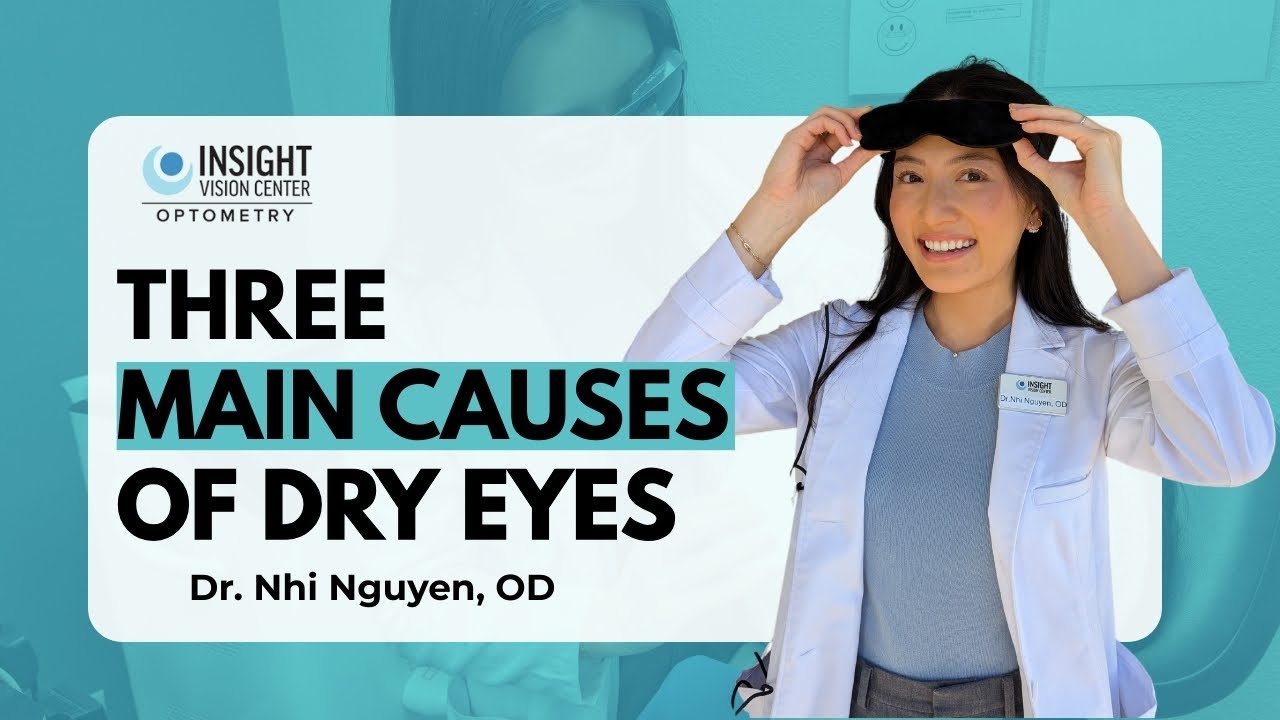
Prefer to watch? Our doctors explain what causes dry eye and walk through some of the treatments that help.
For most people, dry eye is a chronic condition to manage rather than a one-time problem to cure, especially when it's tied to aging, hormones, or an underlying gland issue. The goal of treatment is consistent comfort and protecting the surface of the eye long-term, which usually means an ongoing (though often simple) routine rather than a single fix.
If you're wondering when to get it checked, we've written about why early treatment for dry eye matters.
If you've been looking for a dry eye doctor near you, two of our optometrists focus on dry eye care and see patients at both our Costa Mesa and Irvine offices.
Dr. Nhi Nguyen, OD has built her practice around three areas where patients often struggle: dry eye disease, scleral and specialty contact lenses, and slowing the progression of nearsightedness in children. She earned her Doctorate of Optometry, magna cum laude, from the Southern California College of Optometry at Marshall B. Ketchum University, and was born and raised in Orange County.
Dr. Jeffrey Kamo, OD, FAAO completed his Cornea and Contact Lens Residency at the University of California, Berkeley, and is a Fellow of the American Academy of Optometry. Dry eye disease management is one of his specialties, alongside specialty and scleral contact lenses and myopia management.
Drops labeled for "redness relief" work by constricting blood vessels rather than adding lubrication, and with regular use can lead to rebound redness. For dry eye, preservative-free lubricating artificial tears are generally the better everyday choice. Ask us which brand fits your specific type of dry eye. You can also read whether you can overuse eye drops.
Yes, indirectly. We blink significantly less often when focused on a screen, which lets the tear film evaporate faster and can worsen both symptoms and underlying gland dysfunction over time.
Yes. Hormonal shifts around menopause are a well-established contributor to dry eye in women, which is one reason dry eye becomes more common with age, particularly in women over 50. Here's how we approach menopause-related dry eye.
Simple measures like consistent artificial tears and warm compresses can bring relief within days to a couple of weeks. More involved treatments like IPL or prescription drops typically take several weeks to show their full effect, since they're addressing inflammation and gland function rather than providing instant lubrication.
Not necessarily, but your contact lens type, wear schedule, and drop routine may need adjustment. Some patients with contact-lens-related dryness do well switching to daily disposables or, in some cases, exploring Ortho-K, which is only worn overnight.
See all the options on our Contact Lenses page, or read about the best contact lenses for dry eye.

Yes. Both locations offer full dry eye evaluations and treatment, including IPL therapy, so you can pick whichever office fits your schedule.
Book a dry eye evaluation if any of these sound familiar:
Not sure yet? Our dry eye quiz is a quick first step.
Tired of gritty, burning eyes that drugstore drops just don't fix? Find out what's actually causing your dry eye.
Not ready to book yet? Take our dry eye quiz first.
We have two Orange County offices. Our Costa Mesa office is on Airway Avenue near John Wayne Airport and South Coast Plaza, and our Irvine office (Optometry Corner) is on Irvine Boulevard. You'll find hours and directions for both on our locations page.
Insight Vision Optometry, Costa Mesa
3151 Airway Ave, Suite M3, Costa Mesa, CA 92626
714-486-3315
Request an appointment in Costa Mesa
Insight Vision Optometry, Irvine (Optometry Corner)
4940 Irvine Blvd, Suite 102, Irvine, CA 92620
714-730-9580
Request an appointment in Irvine
