Frame (1)
Vector 7 (9)
Ellipse 29 (1)
Ellipse
Ellipse
Ellipse
Ellipse

Orange County's Most Advanced Optical

Transparent Kids (10)

Your Eyes Deserve More than a Standard Lens

We carry everything from everyday single vision to the most advanced lens technology available. But because our optometrists work with so many complex and hard-to-solve cases, we've invested heavily in the tools and lens options to fit virtually anyone who can wear glasses. If it exists, we can probably build it for you.

Traditional lenses are manufactured using general assumptions about how your eyes sit behind the frame. Digitally designed lenses eliminate that guesswork. Using systems like OptiKam, we capture the exact position of your pupils, the tilt of the frame on your face, the distance from your eyes to the lens, and your natural head posture, all measured down to fractions of a millimeter.

That data feeds directly into the lens design so every optical zone is positioned precisely where your eyes need it. The result is sharper vision across the entire lens, smoother transitions in progressive lenses, wider fields of view, and significantly better peripheral clarity. This is especially important for complex prescriptions and progressive lens wearers who have struggled with narrow reading zones or swimmy side vision.

We also finish and verify lenses in-house, giving us a level of precision and quality control that most optical shops simply can't offer. From cutting and edging to final inspection, your lenses are handled by our team from start to finish so nothing is left to chance.

If you wear progressive lenses and have dealt with narrow reading areas, blurry edges, or that "swimming" feeling when you turn your head, the issue is usually the lens design, not your eyes. Essilor Varilux progressives are among the most advanced multifocal lenses available, using AI-driven surface calculation and behavioral data to create a lens that adapts to how you actually move and use your vision throughout the day.

The result is a wider, more stable field of view at every distance, smoother transitions between near, intermediate, and far zones, and a significantly easier adaptation period for first-time progressive wearers. Combined with our digital measurements, each Varilux lens is positioned and optimized specifically for your frame, your face, and your visual habits.

For patients who have tried progressives before and given up, or who have been told they're "hard to fit," Varilux paired with our precision measurement process is often the combination that finally makes progressives work.

Standard progressives are designed to prioritize distance vision, which means your near and intermediate zones are compressed into a small area at the bottom of the lens. That's fine for walking around, but if you spend hours at a desk, on a computer, or moving between screens and paperwork, you're forcing your eyes to work through the narrowest part of the lens all day long.

Computer and office lenses flip that priority. They're digitally designed to give you a wide, relaxed field of view at screen distance and reading distance, with enough intermediate range to see across a desk, a conference table, or a room. Your eyes aren't straining through a tiny corridor of clear vision anymore. Instead, the entire lens is optimized for the distances where you actually spend your working day.

If you find yourself tilting your head back, leaning forward, or taking your glasses off to read at your desk, a dedicated computer lens can eliminate those habits and dramatically reduce end-of-day eye fatigue, neck pain, and headaches. Many of our patients keep a pair specifically for work and notice the difference immediately.

If you deal with chronic headaches, eye strain, neck tension, or difficulty focusing after time on screens, the problem may not be your prescription at all. It may be how your eyes align when shifting between distances. Even a small misalignment forces your eye muscles to constantly compensate, creating a buildup of strain that shows up as pain and fatigue by the end of the day.

Neurolens is the only lens with a contoured prism that adjusts gradually from the top of the lens to the bottom, supporting your eye alignment at every viewing distance rather than just one. It is prescribed based on an objective measurement of your eye alignment at distance and near, so the correction is tailored specifically to where your strain originates.

Neurolens is also used in neuro-optometric rehabilitation for patients recovering from concussion or traumatic brain injury, where eye alignment disruption is common and traditional lenses don't address the underlying binocular coordination issues. Many patients describe the relief as immediate and significant.

When your eyes don't naturally aim at the same point, your brain has to work overtime to merge two misaligned images into one. That effort creates symptoms like double vision, reading difficulty, headaches, dizziness, loss of concentration, and visual fatigue that can affect your ability to work, drive, and function comfortably.

Prism lenses bend light before it enters your eye, redirecting the image so both eyes receive it in alignment without the muscular effort. Our optometrists calculate the exact prism direction, strength, and placement based on a thorough binocular vision evaluation.

Prism is a critical tool in neuro-optometric rehabilitation as well. For patients recovering from stroke, concussion, or traumatic brain injury, prism lenses can help restore spatial awareness, improve balance, reduce visual overwhelm in busy environments, and support the brain's ability to process visual information as it heals. In many of these cases, prism is not just about comfort but about helping patients return to daily life with greater confidence and independence.

If you have a significant prescription difference between your two eyes, you've probably noticed that standard glasses never feel quite right. That's because conventional lenses create two different-sized images, one for each eye, and your brain struggles to fuse them into a single clear picture. This can cause headaches, depth perception issues, eye fatigue, and a general sense of visual discomfort that's hard to explain but impossible to ignore.

SHAW lenses solve this by designing both lenses as a matched binocular pair. Rather than optimizing each lens independently, the SHAW system calculates them together so the image size, magnification, and distortion are balanced between your two eyes. The result is a more natural, relaxed visual experience where your brain can combine the images from both eyes without fighting against the lenses.

For patients who have been told "you'll just have to get used to it" or who have given up on glasses in favor of contact lenses because frames never felt right, SHAW lenses can be the solution that finally works.

For some patients, lenses aren't about sharpening a line on an eye chart. They're about improving quality of life. Therapeutic lenses are prescribed to manage specific visual and neurological conditions where the right lens filter, tint, or design can make a meaningful difference in how someone experiences the world every day.

For patients with light sensitivity, migraines, or post-concussion symptoms, precision-tinted lenses like FL-41 filter the specific wavelengths of light that trigger discomfort and pain. Each tint is selected based on your individual symptoms and visual profile rather than a generic filter.

For patients with sensory processing difficulties, certain tints and filters can reduce visual overstimulation and create a calmer, more manageable visual environment. For individuals with low vision, therapeutic lens designs can enhance contrast, reduce glare, and maximize the usable vision a patient has, helping them read, navigate, and engage with their surroundings more independently.

For patients recovering from traumatic brain injury, therapeutic lenses may combine tints, prism, and customized optical designs to address the multiple layers of visual disruption that often accompany brain injuries. Every therapeutic lens we prescribe starts with a detailed evaluation of how your visual system is functioning and what specific challenges you are facing, so the lens is built around your needs rather than a general category.

The Technology Behind Your Sharpest Vision

Most optical shops measure your glasses by hand, marking your pupil position with a felt-tip pen and estimating distances by eye. We use OptiKam, a digital measurement system that captures the exact position of your pupils, the tilt and curve of your frame, the pantoscopic angle, the vertex distance between the lenses and your eyes, and your natural head posture, all based on how the glasses actually sit on your face.

That data is used to position each lens with sub-millimeter precision, which translates to a wider zone of clear vision, smoother progressive transitions, and less edge distortion. This is especially critical for digitally designed lenses and Essilor Varilux progressives, where the lens surface is calculated around your specific measurements. Even a one-millimeter error in pupil height or segment placement can narrow your reading zone or introduce unwanted peripheral blur.

If you've ever felt like a pair of glasses was close but not quite right, or if you've struggled to adapt to progressives, this level of accuracy is often what makes the difference.

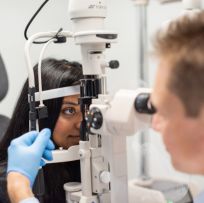
A standard prescription measures how your eye focuses light at two basic levels: sphere and cylinder. But your eye's optical system is far more complex than that. We use Pentacam corneal topography to build a detailed 3D map of your entire corneal surface, measuring elevation, curvature, and thickness across thousands of data points. This gives our optometrists a complete picture of your corneal shape, including subtle irregularities that a standard exam can't detect.

We also use the Tomey WaveDyn wavefront aberrometer to measure exactly how light travels through your entire visual system, capturing higher-order aberrations like coma, trefoil, and spherical aberration that cause glare, halos, ghosting, and reduced contrast, especially at night. This is the same measurement data that drives our HERO wavefront-guided scleral lens designs and informs how we optimize glasses for patients with complex visual needs.

Together, these technologies give our optometrists a complete view of your optics that goes far beyond what a refraction alone can tell us. This is especially valuable for patients with keratoconus, prior eye surgery, corneal transplants, or complex prescriptions where standard glasses or contacts have never quite delivered the clarity they should.

Anterior segment OCT uses light-based imaging to create high-resolution cross-sectional views of the front structures of your eye, including the cornea, iris, anterior chamber, and the space where contact lenses sit. This allows our optometrists to see beneath the surface and measure corneal thickness, evaluate tear film dynamics, and assess the precise clearance between a scleral lens and your corneal surface in real time.

For contact lens patients, this imaging is critical. It lets us verify that a scleral lens is vaulting properly over your cornea without applying pressure, that there is adequate fluid exchange beneath the lens, and that the lens is settling correctly over the course of a wearing day. For patients with dry eye, it helps us evaluate the tear layer and corneal surface health to guide treatment decisions.

This technology also plays an important role in monitoring conditions like keratoconus, corneal ectasia, and post-surgical changes, where tracking subtle shifts in corneal structure over time is essential for staying ahead of progression and adjusting your lenses before problems develop.

A child's prescription tells you what their vision is today. Axial length measurement tells you where it's heading. We use optical biometry to measure the physical length of your child's eye with extreme precision, because it is the elongation of the eyeball that drives myopia progression and increases the risk of serious eye conditions like retinal detachment, glaucoma, and macular degeneration later in life.

By tracking axial length at every visit, our optometrists can detect growth trends before they show up as a prescription change, evaluate whether a myopia management treatment is working effectively, and make adjustments to the treatment plan early rather than reactively. This is a more objective and sensitive measure of myopia progression than prescription changes alone, and it is the gold standard used in clinical research for evaluating myopia control outcomes.

Axial length monitoring is a core part of every myopia management plan at our practice, whether your child is in Stellest lenses, MiSight contacts, Ortho-K, or atropine therapy.

Persistent headaches, neck tension, and eye strain aren't always a prescription problem. They can stem from a subtle misalignment between your eyes, one that's too small for standard testing to catch but significant enough to cause daily discomfort. These misalignments force your eye muscles to constantly compensate to keep both eyes pointed at the same target, and that muscular effort accumulates throughout the day.

Our Neurolens measurement system uses eye-tracking technology to objectively detect and quantify these misalignments at distance and near with a degree of precision that traditional cover test methods can't achieve. The system measures your eye alignment dynamically as your gaze shifts between viewing distances, capturing the exact point where strain begins.

When a misalignment is found, your lenses are built with contoured micro-prism that gently brings your eyes into alignment and relieves the strain at its source, not just the symptoms. This same measurement capability also supports our prism lens prescriptions for patients in neuro-optometric rehabilitation following concussion, stroke, or traumatic brain injury.

Most optical shops send your lenses out to an external lab, which means your glasses pass through multiple hands before they reach you, and any error in edging, mounting, or alignment may not be caught until you're already wearing them. Having a finishing lab in our office changes that entirely.

We edge, cut, and mount many lenses right here, with direct quality control at every step. Each pair is verified against your digital measurements for optical center placement, segment height, and lens orientation before it leaves the lab. If anything needs fine-tuning, we can adjust it immediately rather than sending the glasses back and waiting days for a remake.

You get a faster turnaround, tighter quality control, and the assurance that your glasses have been personally checked for accuracy, fit, and optical performance before you pick them up.

A Kids Optical Built from the Ground up for Kids

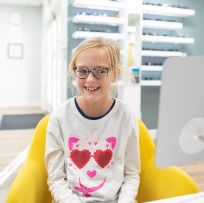
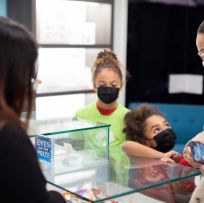
Bringing your child to the eye doctor should never feel stressful, for them or for you. That is why our office was built with kids in mind, from the prize desk that makes every visit feel like a reward to our Treehouse exam room where eye exams feel more like an adventure than an appointment. We even have a dedicated children's optical area so your child can browse frames in a space designed for them.

Our optometrists and team have years of hands-on experience working with children of all ages, including infants, toddlers, preschoolers, and teens. We use equipment specifically designed for pediatric patients, including axial length measurement to track how your child's eyes are growing over time and catch changes early. This allows us to give truly tailored advice about your child's vision rather than a one-size-fits-all approach.

With over 600 five-star reviews and a 4.9 rating across Google and Yelp, Orange County families trust us with their children's vision for a reason. The goal is simple: your kids will love coming here, and they will love the way they see when they leave.

Children are not just small adults, and their glasses should never be scaled-down adult frames forced onto a small face. Kids have underdeveloped nasal bridges that are flatter and wider than adults, which means pediatric frames need lower, wider bridges and often use silicone saddle-style nose pads instead of standard adjustable pad arms. Babies and infants have essentially no nasal bridge at all, so they need even more carefully chosen solutions.

That is why we carry a curated selection of the best pediatric frame brands in the industry.

Tomato Glasses feature a patented adjustable nose pad system with three to five height settings, six adjustable temple length positions, and frames weighing only 7 to 8 grams, all made from flexible, durable TR90 material that bounces back instead of breaking.

Miraflex and Solo Bambini offer wrap-around flexible designs with ultra-flat bridges for infants, held securely with elastic head straps that keep the frames in place no matter how active your little one is.

Nano Vista provides virtually indestructible silicone and rubber frames built for toddlers and young children who are tough on everything they touch.

Liberty Sport and Wiley X Youth deliver sport-specific rec specs with impact-rated protection for active kids who need eyewear that can keep up with them on the field, court, or playground.

Every frame we carry is sized specifically for children's facial proportions, not just shrunk-down versions of adult styles.

We believe every child deserves glasses that fit properly and stay in place, regardless of their facial structure or medical history. Finding the right frame is not just about comfort. A poorly fitting frame affects lens position, which means your child may not be seeing through the right part of the lens, even if the prescription itself is perfect.

For children and adults with Down syndrome, standard frames almost never work. A very flat nasal bridge, wider facial features, and a smaller head circumference require frames with custom-lowered bridges, extra-wide fronts, and shortened temples. We carry frames from Specs4Us and Erin's World, which are specifically engineered for these patients and designed to stay in place all day.

For families who need low bridge fit options, sometimes called "Asian fit," we carry frames with larger built-in nose pads, adjusted lens tilt, and curved temples that prevent sliding and resting on cheekbones. This is common among East Asian, Southeast Asian, African American, and Hispanic patients, though anyone with a flatter nasal bridge can benefit.

We also work with post-surgical patients following rhinoplasty or nasal fracture repair who need nose-pad-free designs, as well as children on the autism spectrum who may need specific frame features for sensory comfort, such as lighter weight materials, smooth temple tips, and minimal pressure points.

Whatever the need, our goal is to find a frame your child will actually want to wear and that will stay where it belongs.

If your child's nearsightedness keeps getting worse year after year, there is now an eyeglass lens that does more than sharpen their vision. Essilor Stellest lenses were authorized by the FDA as the first spectacle lens designed to actually slow myopia progression in children ages 6 to 12. The lens features a clear central zone for crisp everyday vision surrounded by a ring of over 1,000 tiny "lenslets" that gently shift how light enters the eye, sending a signal that helps slow the elongation of the eyeball, which is the main driver of worsening nearsightedness.

Clinical studies showed a 71% slower rate of myopia progression over two years compared to standard single-vision lenses, 53% less axial elongation in the same period, and long-term data showing a reduction of more than 1.75 diopters over five years. No serious safety concerns were reported in clinical trials, and best results are seen when worn at least 12 hours per day.

Dr. Thanh Mai, OD, FSLS, FIAOMC serves on the EssilorLuxottica advisory board for Stellest lenses, which means your child has direct access to one of the optometrists helping shape how these lenses are prescribed and fitted nationally. That level of clinical involvement translates into more precise fitting and better outcomes for your child.

Stellest lenses are an ideal starting point for families looking for a non-invasive, low-maintenance approach to myopia management. They look and feel like regular glasses, require no special care beyond normal cleaning, and can be part of a progressive care plan that may later include contact lens options or atropine therapy as your child grows.

For children who are ready for contact lenses, we offer the most advanced myopia management options available. These are not standard contacts. They are purpose-built to slow the progression of nearsightedness while providing clear, comfortable vision. Our fellowship-trained optometrists, including Dr. Nathan Schramm, OD, FSLS, FBCLA and Dr. Thanh Mai, OD, FSLS, FIAOMC, have advanced training in fitting pediatric and complex contact lenses, so your child's lenses are designed and monitored with a higher level of clinical precision.

MiSight is the first FDA-approved daily disposable soft contact lens for myopia control. Its dual-focus design corrects distance vision in the center while providing peripheral defocus that signals the eye to slow its growth. In clinical studies, MiSight slowed myopia progression by approximately 59% over three years, with six-year follow-up data showing 71% reduction in later years. Because they are daily disposables, there is no cleaning or overnight storage required, which makes them a great option for younger children and busy families.

NaturalVue multifocal lenses use an extended depth-of-focus design that creates a continuous range of focus, reducing the stimulus for eye elongation. Studies with nearly 200 children showed progression slowed by approximately 85%, with 79% of patients experiencing at least 70% improvement.

Custom soft contact lenses are also available for children with more complex prescriptions or fitting needs, including options for irregular corneas, scleral lenses, and prosthetic lenses for cosmetic concerns. Our team will help determine which lens is the best match based on your child's age, prescription, lifestyle, and comfort level with contact lens wear.

Orthokeratology, or Ortho-K, is one of the most effective and proven tools for slowing childhood myopia, and it comes with a benefit no other option offers: glasses-free, contact-free vision during the day. Ortho-K lenses are custom-fitted rigid lenses worn only at night while your child sleeps. They gently reshape the cornea overnight so that when your child wakes up and removes the lenses, they can see clearly all day without any glasses or contacts.

Beyond the convenience of daytime lens-free vision, Ortho-K addresses the root cause of worsening myopia. Traditional glasses correct central vision but leave peripheral light focused behind the retina, which can actually encourage the eye to keep growing longer. Ortho-K reshapes the cornea so that peripheral light is focused in front of the retina instead, creating what researchers believe is a "stop signal" that tells the eye to slow down its growth. Studies have shown this can reduce myopia progression by approximately 50% compared to standard corrective lenses.

Because Ortho-K lenses are custom-fitted to each eye and have a large range of parameters, they can treat moderate to high levels of myopia and astigmatism, making them a strong option even for children with more complex prescriptions. And because the lenses come out in the morning, they are ideal for kids who play sports, swim, or simply do not want to wear glasses during the day.

For some children, the most effective myopia management plan includes low-dose atropine eye drops, either on their own or combined with another treatment like Ortho-K, Stellest lenses, or MiSight contacts. Atropine has been used in eye care for decades, and at low concentrations it has been shown to slow myopia progression with minimal side effects.

The drops are typically administered once a day at bedtime, making it one of the simplest treatments to incorporate into a child's routine. Low-dose atropine is especially useful for younger children who may not yet be ready for contact lenses or for patients whose myopia is progressing rapidly and would benefit from a combination approach. Our optometrists will monitor your child's response over time and adjust the treatment plan as needed to ensure the best possible outcome.

Every child's myopia management plan is different. As part of our Treehouse Eyes myopia management program, our team evaluates your child's full picture, including their prescription, rate of progression, axial length measurements, age, lifestyle, and family history, to recommend the right combination of treatments to protect their long-term vision.

Contact Lenses for Eyes That Don't Fit the Standard Mold

Our fellowship-trained optometrists, including Dr. Nathan Schramm, OD, FSLS, FBCLA and Dr. Thanh Mai, OD, FSLS, FIAOMC, fit patients who have been told contact lenses aren't an option. With access to over 650 lens designs and advanced diagnostic imaging, every lens is matched to the unique shape and optical profile of your eyes.

Scleral lenses vault over the entire cornea and rest on the white of the eye, creating a smooth optical surface and a protective cushion of preservative-free saline between the lens and your cornea. This design makes them ideal for patients with keratoconus, pellucid marginal degeneration, corneal transplants, high astigmatism, and post-refractive surgery complications from procedures like LASIK, PRK, or radial keratotomy.

Scleral lenses are also one of the most effective therapeutic options for patients with severe dry eye, Sjögren's disease, and allergic conjunctivitis. The saline reservoir beneath the lens continuously bathes and hydrates the corneal surface, providing relief that artificial tears and other treatments may not achieve on their own.

Because the lens never touches your cornea, many patients find sclerals significantly more comfortable than traditional gas permeable lenses, and the stable fit means consistent, clear vision throughout the day, even during sports and physical activity. For patients with corneal swelling, we also offer channeled scleral lens designs that promote fluid exchange beneath the lens for better corneal health over long wearing hours.

The HERO lens is our flagship scleral lens, designed using wavefront-guided aberrometry from the Tomey WaveDyn system to measure and correct higher order aberrations that standard lenses simply can't address. If you experience persistent glare, halos, ghosting, or starbursts, especially at night, the HERO lens is engineered to reduce these visual disturbances and deliver high-definition clarity.

Every HERO lens is built from a detailed map of your eye's unique optical profile, using laser-guided mapping of both corneal and scleral surfaces to create a lens that fits precisely and corrects beyond what a standard prescription can achieve. For patients with severe aberrations or irregular astigmatism, the HERO lens offers a level of visual precision that can be truly life-changing.

For patients with highly irregular corneas or those who haven't found success with other contact lenses, EyePrintPRO offers a truly one-of-a-kind solution. Rather than relying on measurements alone, EyePrintPRO creates a physical impression of the surface of your eye, capturing every contour, elevation, and irregularity in precise detail. The lens is then custom-manufactured from that mold, resulting in a fit so precise it can provide comfort and visual clarity for even the most complex cases.

This includes patients with severe corneal scarring, post-surgical irregularities, Stevens-Johnson syndrome, and conditions where standard scleral lenses have not achieved an ideal fit. Because the lens is molded directly to your anatomy, many patients who have exhausted other options find that EyePrintPRO finally delivers the comfort and vision they've been looking for.

When your prescription falls outside the range of standard soft contact lenses, custom soft lenses are designed specifically for you. Through our partnership with SpecialEyes and their Guaranteed Fit Policy, we can order lenses in sphere powers up to ±25.00 D and cylinder corrections up to -8.00 D, well beyond what off-the-shelf lenses can provide. Each lens is manufactured to your exact parameters using advanced hioxifilcon and silicone hydrogel materials for excellent oxygen permeability and all-day comfort.

For patients with keratoconus, pellucid marginal degeneration, or other corneal irregularities who prefer the comfort of a soft lens, we also fit KeraSoft IC and NovaKone lenses. These therapeutic soft lenses are designed with customizable parameters that conform to irregular corneal surfaces, providing stable vision without the adaptation period associated with rigid lenses. Our optometrists often recommend these as a first step for newly diagnosed keratoconus patients or as a comfortable daily option for patients managing mild to moderate corneal irregularity.

Hybrid lenses combine the crisp optics of a rigid gas permeable center with the comfort of a soft lens skirt, making them an excellent option for patients with mild to moderate keratoconus, high astigmatism, or those who want sharp vision without adapting to a fully rigid lens. Designs like the SynergEyes Duette and iD Multifocal provide stable, centered optics with the familiar feel of a soft lens. For patients over 40, multifocal hybrid designs deliver clear vision at all distances without the compromise of monovision.

Custom gas permeable (GP) lenses remain one of the most effective options for patients who need the sharpest possible vision from a corneal lens. Our GP fittings are topography-guided, meaning each lens is designed based on detailed corneal mapping. For patients with early-stage keratoconus, moderate astigmatism, or those who simply want the crispest optics available, a well-designed GP lens can outperform soft lenses in visual quality.

For patients who have had LASIK, PRK, radial keratotomy, or a corneal transplant and are still dealing with blurred vision, glare, or visual fluctuations, a well-fitted scleral, wavefront-guided, or custom soft lens can stabilize your vision and significantly improve your quality of life. Our optometrists have fellowship-level training in fitting complex post-surgical corneas, using detailed imaging to design lenses that work with your eye's current anatomy.

Orthokeratology, or Ortho-K, uses custom-fitted rigid lenses worn only at night to gently reshape the cornea while you sleep. When you wake up and remove the lenses, you can see clearly all day without glasses or contacts. Ortho-K is one of the most effective tools for slowing childhood myopia, but it is also an excellent option for adults who want freedom from daytime eyewear, including athletes, first responders, and anyone whose work or lifestyle makes glasses and contacts impractical.

Beyond convenience, Ortho-K addresses the root cause of worsening myopia. Traditional glasses correct central vision but leave peripheral light focused behind the retina, which can encourage the eye to keep growing longer. Ortho-K reshapes the cornea so that peripheral light is focused in front of the retina instead, creating what researchers believe is a "stop signal" that tells the eye to slow its growth. Studies have shown this can reduce myopia progression by approximately 50% compared to standard corrective lenses.

Because Ortho-K lenses are custom-fitted to each eye and have a large range of parameters, they can treat moderate to high levels of myopia and astigmatism, making them a strong option even for patients with more complex prescriptions.

For children and teens with progressive nearsightedness, contact lenses can do more than correct vision. They can help slow the progression of myopia and reduce the risk of serious eye conditions later in life. We offer FDA-approved options including MiSight 1 Day and NaturalVue multifocal daily disposables, as well as SpecialEyes custom multifocal soft lenses with OptiSync® technology for patients who need parameters beyond what standard myopia control lenses offer.

We also fit custom soft lenses for children with complex prescriptions or fitting needs, including small-diameter pediatric designs (13 to 13.6 mm) for younger patients and infant aphakia lenses for babies who need vision correction after cataract surgery. Dr. Thanh Mai, OD, FSLS, FIAOMC serves on the EssilorLuxottica advisory board and is part of our Treehouse Eyes myopia management program, working closely with each family to determine which approach best fits your child's age, prescription, lifestyle, and comfort level.

For patients with iris atrophy, aniridia, corneal scarring, or other conditions that affect the appearance or function of the eye, we offer a range of custom prosthetic, tinted, and pinhole lens designs. Prosthetic lenses are hand-painted or digitally matched to your natural iris color and pattern, restoring a symmetrical, natural look while reducing light sensitivity and glare.

For patients with irregular pupils or iris defects, pinhole soft lenses can minimize visual disturbances and improve functional vision. We also fit custom tinted lenses designed for sports performance, with wavelength-specific filtering for activities like golf and shooting that enhances contrast and depth perception. Whether the goal is cosmetic restoration, visual comfort, or a competitive edge, these lenses are tailored to your specific needs.

Glasses That Do More than Correct Your Child’s Vision

Essilor Stellest lenses are the first FDA-authorized eyeglass lenses proven to slow the progression of childhood myopia. For families looking for a non-invasive starting point for myopia management, Stellest offers real clinical results in a lens your child can wear just like any other pair of glasses.

Rectangle 90 (2)
Rectangle 91 (3)

You’ll Feel the Difference from Your First Visit

From the moment you walk in to the moment you pick up your glasses or contacts, every step of your experience is handled by a team that takes precision and patient care personally. A 4.9-star rating across 600+ reviews on Google and Yelp doesn't happen by accident. It happens when every person on the team, from the front desk to the opticians to the doctors, treats you like family, and that is why families across Costa Mesa, Huntington Beach, Newport Beach, Irvine, and beyond choose Insight Vision Center.

Patient Feedback


Google Reviews 4.9

Reviews

(485)
Wide Kid

More Eyewear Resources

Choosing the right eyeglasses or contact lenses involves more than picking frames or ordering lenses. It is about finding the right option for your specific needs. Explore these helpful pages to learn about vision correction. Our team is here to help you see clearly and comfortably.